
Interior planting contributes to multiple WELL v2 concepts, most significantly the Biophilic Design Optimization within the Mind concept, which awards points for incorporating living nature into the built environment. Well-specified living walls also support WELL Sound credits: tested systems achieve acoustic absorption coefficients of up to 0.96, making them legitimate inputs to reverberation calculations (acoustic testing studies, 2018 to 2023). For New Zealand projects, GreenAir's experience confirms that the credit case is strongest when planting is written into the design brief from the outset, not added after practical completion.
WELL v2, administered by the International WELL Building Institute, operates across ten concepts: Air, Water, Nourishment, Light, Movement, Thermal Comfort, Sound, Materials, Mind and Community. Within each concept, features are classified as either Preconditions, mandatory for any certification level, or Optimizations, which are points-based and contribute to Silver, Gold or Platinum ratings. Interior planting is most relevant to Optimizations. It builds on a mechanically compliant base rather than substituting for one.
Architects and specifiers frequently underestimate the number of WELL concepts that well-designed interior planting can touch. The Biophilic Design Optimization is the most direct route to points, but Air, Sound and even Light connections each deserve examination before the planting brief is finalised.
Which WELL v2 concepts does interior planting directly support?
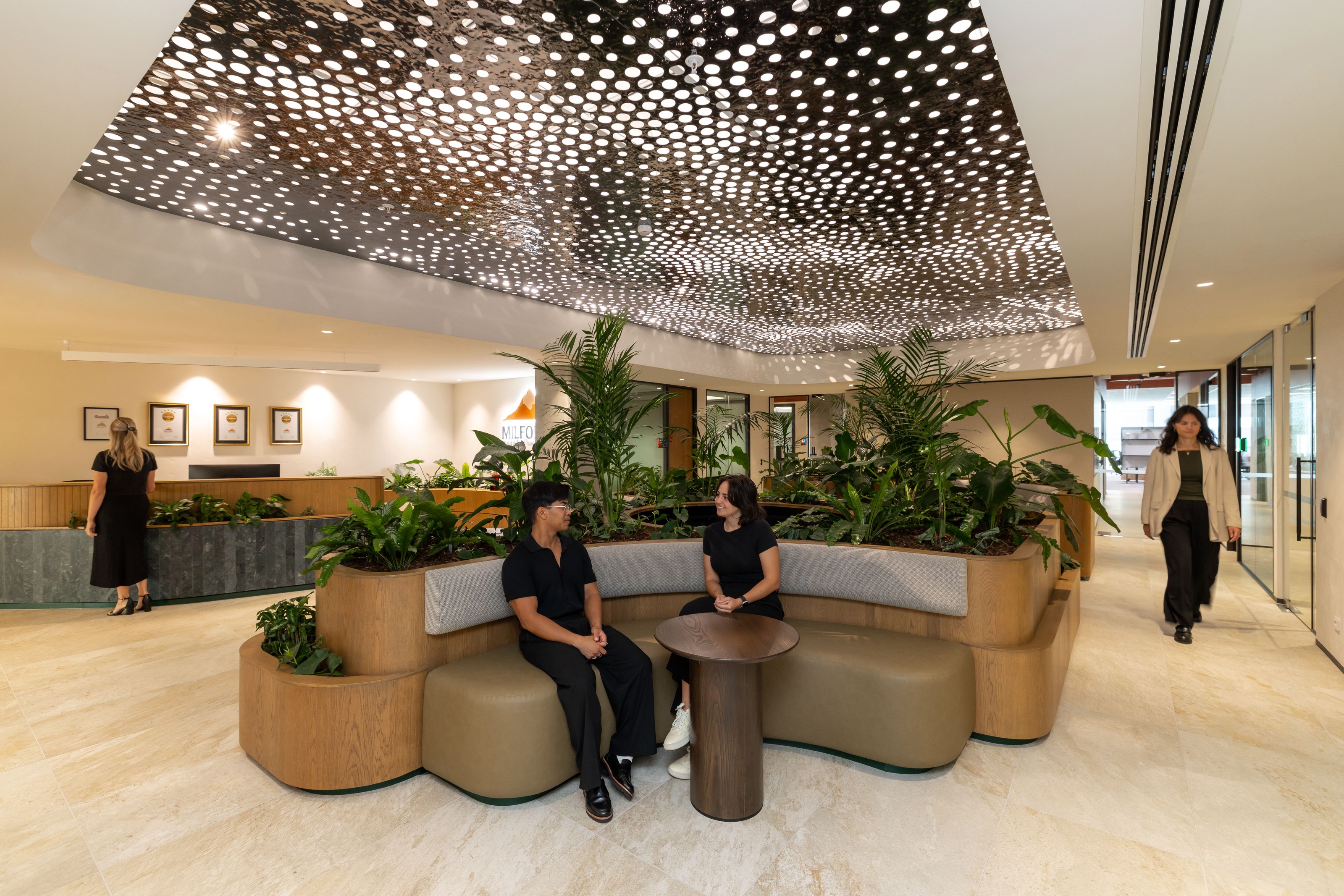
Interior planting has a confirmed, points-relevant contribution to three WELL v2 concepts: Mind, Air and Sound. The strength of contribution varies by mechanism, system type, and the specific feature being targeted.
The Mind concept is where interior planting delivers its most direct and points-certain contribution. The Sound connection is real and measurable when the correct system is specified. The Air contribution requires care and honest framing, more on that below.
| WELL v2 Concept | Relevant Feature | Planting Contribution | Feature Type |
|---|---|---|---|
| Mind | Biophilic Design Optimization | Living plants, green walls, nature-in-space coverage | Optimization |
| Sound | Sound Reducing Surfaces | Acoustic absorption, living walls, moss walls | Optimization |
| Air | Enhanced Air Quality | Perceived air quality (not a substitute for mechanical systems) | Optimization |
| Light | Daylight Design Strategies | Indirect, plant placement relative to daylight zones | Optimization |
How does the Biophilic Design Optimization work in practice?
The Biophilic Design Optimization under the Mind concept awards points for incorporating three categories of biophilic experience: Nature in Space, Natural Patterns and Processes, and Nature of the Space. Living interior plants contribute directly to Nature in Space, the most accessible sub-feature for commercial fit-outs, and the one with the most straightforward calculation methodology.
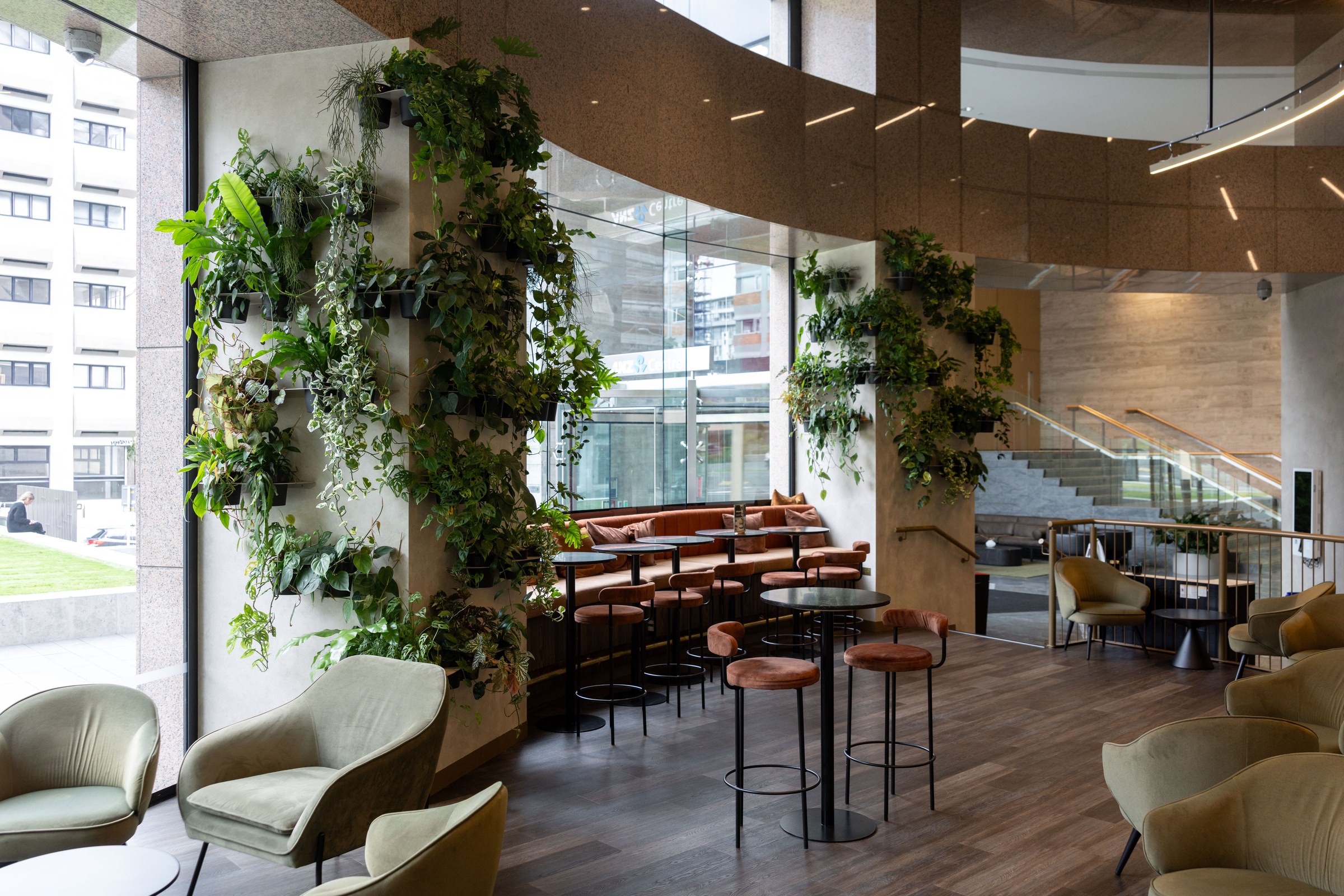
To achieve points under Nature in Space, projects typically need to demonstrate minimum plant coverage relative to occupiable floor area, species diversity, and a documented ongoing maintenance programme. Living green walls count towards area coverage targets more efficiently than distributed container plants, because they deliver measurable coverage in a defined, testable format. For specifiers, the choice between a statement green wall and distributed containers is not purely an aesthetic one, it determines whether the coverage calculation reaches the threshold for points.
The Biophilic Design Optimization is one of the more attainable Mind credits in a commercial fit-out because it does not require specialist equipment, complex commissioning, or structural modification. It requires a well-specified, professionally maintained planting installation, with documentation to match.
Can interior planting contribute to WELL Air credits?
With important caveats. Plants are not a substitute for mechanical ventilation and air filtration systems, and the evidence for significant VOC removal in real-world commercial conditions is mixed. WELL's Air concept is primarily addressed through ventilation rates, filtration efficiency, and VOC source control from building materials, not through biological systems.
Where interior planting can support Air features is through occupant-reported air quality, a component of some WELL Air Optimizations that rely on post-occupancy survey data. Environments with interior plants consistently score higher on perceived air quality assessments, even where measured air quality is equivalent to plant-free environments. Research by Nieuwenhuis et al. (Journal of Experimental Psychology: Applied, 2014) found that occupants in planted offices reported significantly higher perceived air quality alongside the 15% productivity gain measured across 300+ participants in the Netherlands and the United Kingdom.
For WELL submissions that incorporate occupant experience surveys, this is worth documenting. It should not be overstated as an air treatment system.
How do living walls and moss walls contribute to WELL Sound credits?
This is where system specification determines the credit outcome. WELL's Sound concept includes features around reverberation time (T60) and background noise levels, both of which are influenced by the acoustic absorption properties of interior surfaces, including planted wall systems.
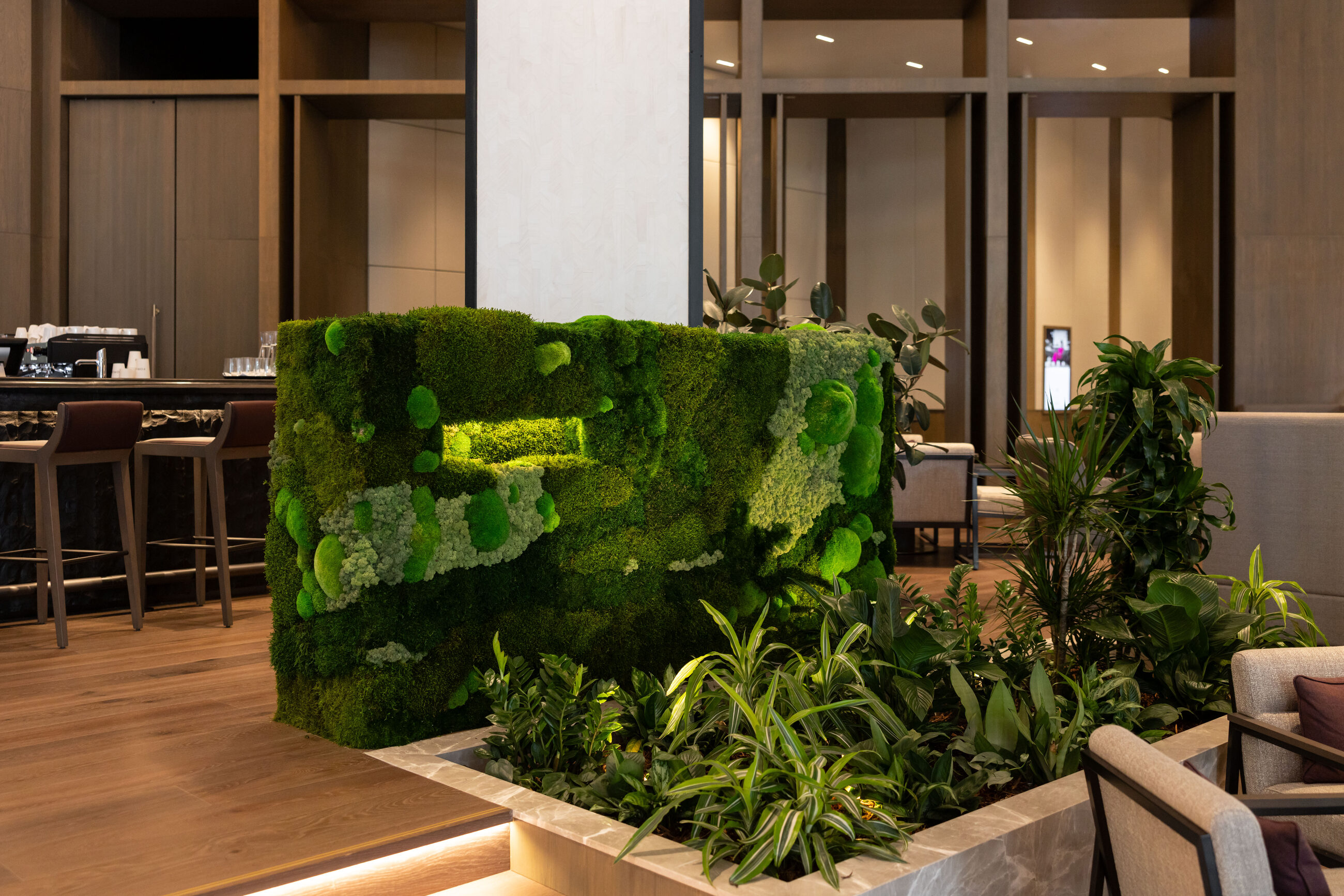
Research by Azkorra et al., Davis et al. (2017), and Wong et al. (2014 to 2017) demonstrated that living green walls display acoustic absorption comparable to or better than common building materials, with particular performance at voice frequencies around 60 dB. Moss walls are the highest-performing system: absorption coefficients of up to 0.96 and noise reduction of up to 10 dB in tested conditions (acoustic testing studies, 2018 to 2023). By comparison, a 10 dB reduction is perceived as roughly halving the loudness of a sound.
For a project calculating T60 across a hard-surfaced open-plan floor, including a living or moss wall in the acoustic material schedule, with its tested absorption coefficient, is appropriate and defensible. Specifiers should base acoustic contribution claims on tested system data, not generic estimates. Substrate material, plant density, and system depth all affect measured performance, and these variables should be confirmed with the installation provider before inclusion in the acoustic model.
What does this mean for New Zealand projects pursuing WELL or Green Star?
WELL certification is growing in New Zealand's commercial market, particularly among corporate tenants with ESG commitments and developers competing for quality occupiers in Auckland and Wellington. Green Star NZ, administered by the New Zealand Green Building Council, offers a parallel pathway: its Indoor Environment Quality (IEQ) category includes provisions for interior planting that align closely with WELL's Nature in Space requirements.
GreenAir works with architects and project managers at the briefing stage to document planting specifications in a format assessors can evaluate: coverage calculations, species schedules, maintenance programmes, and where relevant, acoustic system test data from the manufacturer. At the Majestic Centre in Wellington, GreenAir's smart sensor network, monitoring light, humidity and temperature across 12 zones in real time, provides the kind of ongoing environmental performance data that supports both WELL and Green Star submissions.
The credits for biophilic design aren't difficult to achieve, but they need to be in the brief from day one. Species selection, coverage calculation, and the maintenance programme all need to hold up to assessor scrutiny. That conversation is much easier at design development than it is at practical completion. Simon Chamberlain, GreenAir
Key takeaways
- Interior planting contributes most directly to the Biophilic Design Optimization within WELL v2's Mind concept, one of the more attainable Optimization credits available in a commercial fit-out.
- Living green walls and moss walls are measurable acoustic materials: tested systems achieve absorption coefficients of up to 0.96, qualifying as inputs to WELL Sound reverberation calculations (acoustic testing studies, 2018 to 2023).
- Plants are not an air treatment system and should not be represented as one in WELL submissions; their Air concept contribution is through occupant-perceived air quality, not measured VOC removal.
- Green Star NZ's Indoor Environment Quality category provides a parallel local certification pathway with closely aligned interior planting provisions.
- The credit case is strongest when planting is specified at design development: coverage calculations, species selection, and maintenance documentation all need to be established before construction, not after.
If you are working on a WELL or Green Star project in New Zealand and need to understand how an interior planting installation can be specified to support certification, talk to the GreenAir team.